
Immunoproteasome Research (Meiners lab)
One focus of research is the immunoproteasome, a specialized form of the proteasome that plays an important role in regulating immune responses. In immune cells, the immunoproteasome (i20S) is constitutively expressed, while in non-immune cells the standard proteasome (s20S) predominates, buti20Scan be induced by inflammatory signals and infections (Figure 1). The immunoproteasome has a different proteolytic activity than the s20S and plays a key role in the regulation of immune and stress responses, such as the activation of CD8 T cells by MHC class I antigen presentation in viral and tumor diseases (Figure 2). However, the exact function of the immunoproteasome in immune cells, in the response to infections, and in chronic lung diseases such as COPD, pulmonary fibrosis, and lung tumors is not well understood.
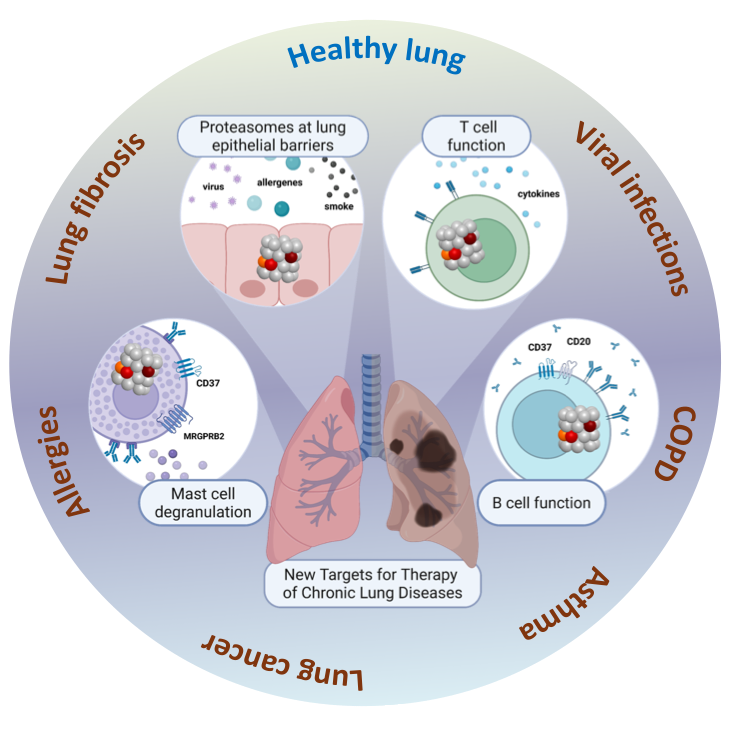
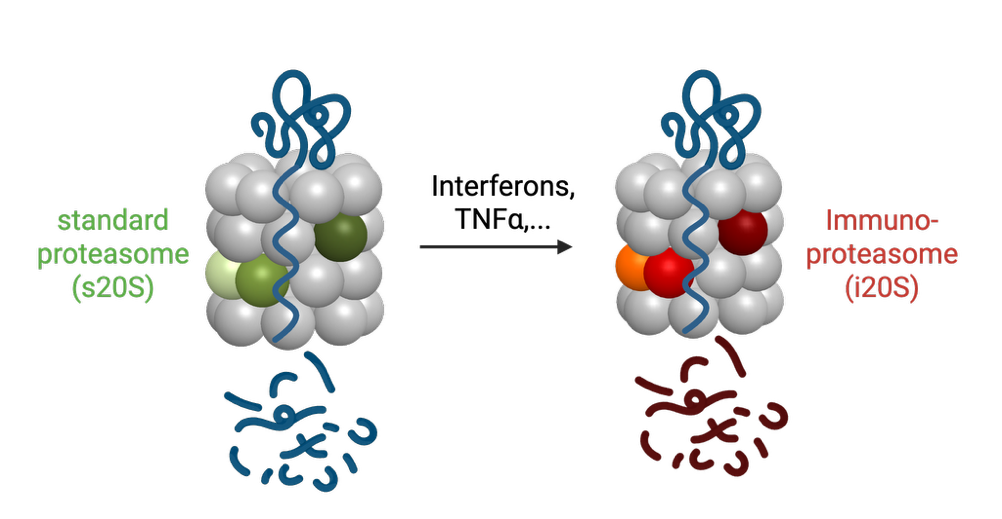
Figure 1: Standard versus immunoproteasome. So-called standard proteasomes are expressed in all non-immune cells. After stimulation with interferons or inflammatory cytokines, immunoproteasomal catalytic subunits are induced and assemble into an active immunoproteasome.
Our research aims to investigate the role of the immunoproteasome in the function of immune and parenchymal cells and its dysregulation in diseases. We are currently establishing novel transgenic animal models for immunoproteasome research, which we intend to use for validation of specific immunoproteasome inhibitors as a new treatment approach for inflammatory and chronic diseases. For clinical studies, we have established methods for the systematic determination of proteasome activity in peripheral blood cells in order to examine large patient or population cohorts for altered proteasome activities.
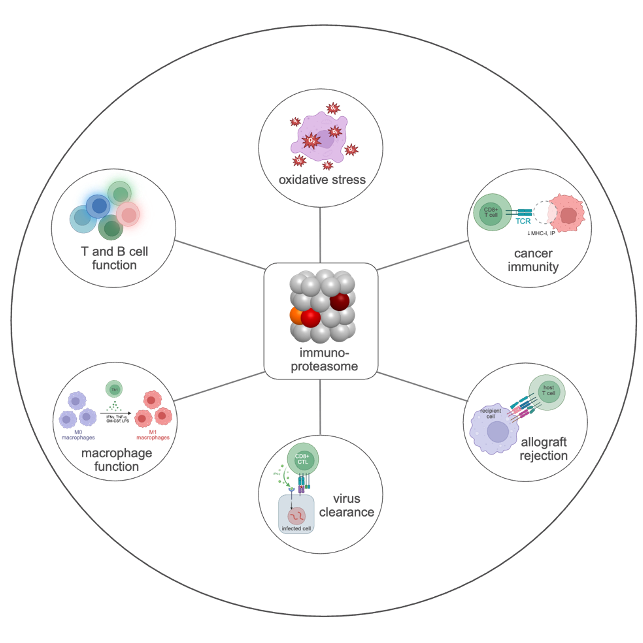
Figure 2: The immunoproteasome has diverse functions in cellular immune and stress responses.
Membranproteins (Orinska Lab)
Our focus is on regulating the function of B cells and mast cells and their role in the immune response in physiological situations and in chronic lung diseases. In particular, we want to understand how membrane proteins of the tetraspanin family are involved in regulating immune cell function and whether/how modulation of tetraspanin function could be used to treat chronic lung diseases. Using various genetic mouse models and antibody-mediated tetraspanin targeting, we characterize cell type-specific interaction partners and functions of these membrane proteins.
Main Projects
Leibniz-Gemeinschaft „ImmunoPROteasomes in LUNG health and disease“ – PRO-LUNG
We here explore the concept that the inducible nature of the immunoproteasome enables dynamic adaptation of proteasome function in immune and stress responses. In particular, we aim to understand whether standard, immuno- and the various types of mixed proteasomes have distinct functions e.g. by localizing to distinct cell types or subcellular sites, degrading different substrates, or by interacting with defined proteasome regulators. Solving these questions is key for a detailed understanding of the function of the immunoproteasome in health and disease. It will pave the way for validation of the immunoproteasome as a therapeutic target allowing specific inhibition of single or multiple immunoproteasome subunits in disease with novel site-specific immunoproteasome inhibitors that are currently being developed.

Leibniz Center for Infection: “Sex-specific regulation of immunoproteasome function determines response to infection“ (together with Bianca Schneider, FZB)
In this project, we investigate the (biological) sex-specific regulation of the immunoproteasome and whether this might contribute to the stronger immune responses against infections in females. We are using influenza and tuberculosis-related infection models in female and male mice to dissect the immunoproteasome related immune response as well as in vitro cellular models for sex-hormone treatment. The aim is to unravel the molecular basis of sex-related regulation of the immunoproteasome, which may enable us to develop sex-specific diagnostic tools and target the immunoproteasome therapeutically in a sex-related manner.

CRC 1713 Maternal Immune Activation
“Role of the Immunoproteasome in Feto-Maternal Immune Activation and Fetal Immune Priming”
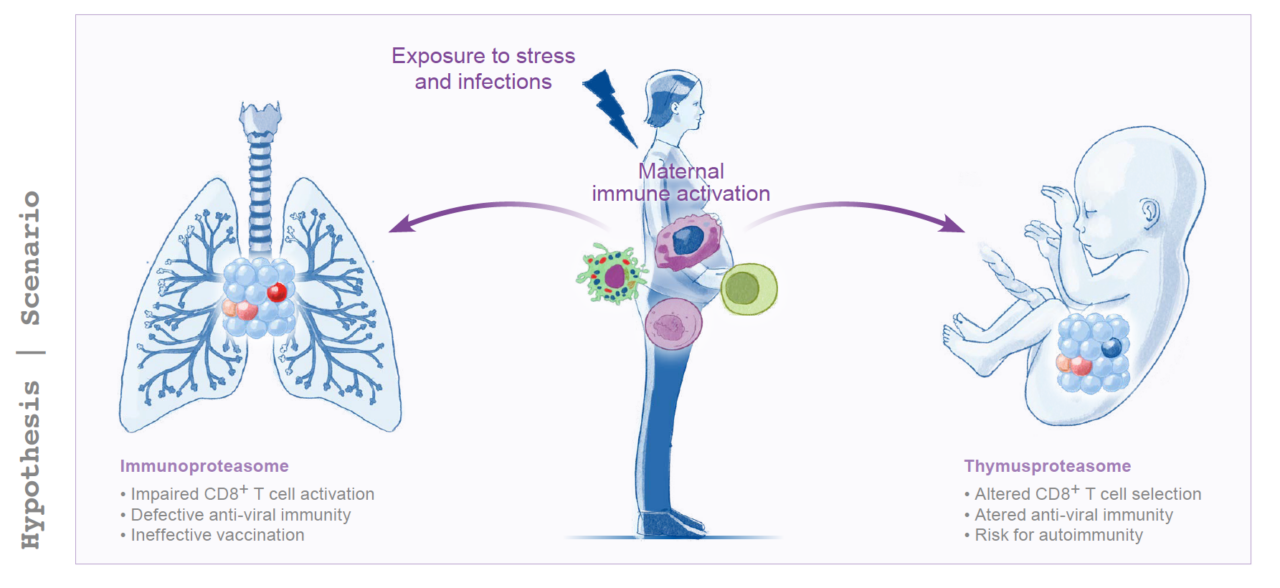
The immunoproteasome plays an essential role in the selection and priming of CD8 T cells. It is therefore central to the establishment of self-tolerance as well as antiviral immunity and autoimmune responses. In this project, we investigate the regulation of the immunoproteasome by stress- and infection-induced maternal immune activation and how this affects antiviral immune responses in the pregnant host, immune priming in the fetal thymus, and the development of tolerance in the offspring.

Priority Program SPP2453 Mitostress
“Regulation of the human proteasome network under mitochondrial protein import stress”
Mitochondria are central to cellular metabolism and the maintenance of proteostasis. Since the majority of mitochondrial proteins are synthesized in the cytosol and subsequently imported, precise regulation of mitochondrial protein import is essential for maintaining cellular function. The aim of this project is to characterize in detail the regulation of the proteasome system under mitochondrial stress conditions. A particular focus is on the mechanisms for rapid adaptation of proteasomal regulation during mitochondrial import stress.

Regulation of MrgprB2-mediated mast cell activation by tetraspanin CD37
Mast cells (MCs) are long-lived sentinel cells of the immune system that control allergic and inflammatory responses. While the tetraspanin CD37 is known to be an important regulator of signal transduction in B cells, its function in mast cell activation remains poorly understood. Here, we investigate how CD37 regulates mast cell activation by comparing two genetic models of CD37 deficiency. Mast cells from conventionally CD37-deficient mice were hypersensitive to IgE-independent, MrgprB2-mediated stimulation. In contrast, mast cells from mast cell-specific CD37 knockout mice showed no altered activability and responded normally to IgE-dependent and independent stimuli. The observed IgE-independent hypersensitivity in conventionally CD37-deficient mice could be due to an off-target effect. To test this hypothesis, we are reconstituting CD37 expression in CD37-deficient mast cells using lentiviral transduction. In addition, we have identified a neighboring gene that is a potential new regulator of mast cell activation.
Modulation of B-cell function through epitope-specific CD37 targeting in mice
CD37 is a glycosylated membrane protein that is strongly expressed in B cells. Like other tetraspanins, CD37 is involved in the regulation of incoming signals, lateral membrane protein interactions, and intracellular signal processing. In this project, we characterize CD37-specific monoclonal antibodies and investigate the effects of epitope-specific CD37 targeting in vitro and in vivo. The CD37-specific monoclonal antibodies recognize two different CD37 epitopes. The binding of the antibodies to CD37 leads to the induction of B cell death in vitro. In mice, the application of CD37 AK also leads to a reduction in various B cell populations. Nevertheless, we also observed a specific immune response to injected antibodies, which indicates the activation of certain B cell populations. In further experiments, we will investigate the mechanisms responsible for B cell depletion that could be used for the treatment of chronic lung diseases. The enhanced induction of an immune response, on the other hand, is important for the development of new vaccine technologies.
Project leader
-

Prof. Dr. Silke Meiners
Principal Investigator+49 4537 1885846
Team
-

Zane Orinska
Senior Scientist+49 4537 / 188-5650, 5720
-

Niels Röckendorf
Senior Scientist+49 4537 / 188-4570
-

Frauke Koops
Lab technician+49 4537 / 188-5720, 5730
-

Gesine Rode
Lab technician+49 4537 / 188-5720, 5730
-
Corinna Schöning
Lab technician+49 4537 / 188-5790/4560
-

Kai Guo
PhD-student+49 4537 / 188-4580
-

Jia-qi Wang
PhD-student+49 4537 / 188-4580
-
Liisa Knipp
PhD-student+49 4537 / 188-4580
-

Bastien Farcy
PhD-student+49 4537 / 188-4580
-

Jinyuan Wang
PhD-student+49 4537 / 188-4580
-

Handan Müftüoglu
Assistance
Publications
-
European Respiratory Journal
·
Antiviral CD8+ T-cell immune responses are impaired by cigarette smoke and in COPD
Chen J, Wang X, Schmalen A, Haines S, Wolff M, Ma H, Zhang H, Stoleriu MG, Nowak J, Nakayama M, Bueno M, Brands J, Mora AL, Lee JS, Krauss-Etschmann S, Dmitrieva A, Frankenberger M, Hofer TP, Noessner E, Moosmann A, Behr J, Milger K, Deeg CA, Staab-Weijnitz CA, Hauck SM, Adler H, Goldmann T, Gaede KI, Behrends J, Kammerl IE, Meiners S
-
Nature Cancer
·
The proteasome regulator PSME4 modulates proteasome activity and antigen diversity to abrogate antitumor immunity in NSCLC
Javitt A, Shmueli MD, Kramer MP, Kolodziejczyk AA, Cohen IJ, Radomir L, Sheban D, Kamer I, Litchfield K, Bab-Dinitz E, Zadok O, Neiens V, Ulman A, Wolf-Levy H, Eisenberg-Lerner A, Kacen A, Alon M, Rêgo AT, Stacher-Priehse E, Lindner M, Koch I, Bar J, Swanton C, Samuels Y, Levin Y, da Fonseca PCA, Elinav E, Friedman N, Meiners S, Merbl Y
-
The EMBO Journal
·
DNA sensing via the cGAS/STING pathway activates the immunoproteasome and adaptive T‐cell immunity
Wang X, Zhang H, Wang Y, Bramasole L, Guo K, Mourtada F, Meul T, Hu Q, Viteri V, Kammerl I, Konigshoff M, Lehmann M, Magg T, Hauck F, Fernandez IE, Meiners S
-
European Respiratory Journal
·
Activation of immune cell proteasomes in peripheral blood of smokers and COPD patients: implications for therapy
Kammerl IE, Hardy S, Flexeder C, Urmann A, Peierl J, Wang Y, Vosyka O, Frankenberger M, Milger K, Behr J, Koch A, Merl-Pham J, Hauck SM, Pilette C, Schulz H, Meiners S
-
Cell Reports
·
Mitochondrial Regulation of the 26S Proteasome
Meul T, Berschneider K, Schmitt S, Mayr CH, Mattner LF, Schiller H, Yazgili A, Wang W, Lukas C, Prehn C, Adamski J, Graf E, Schwarzmayr T, Perocchi F, Kukat A, Trifunovic A, Kremer L, Prokisch H, Popper B; von Toerne C, Hauck SM, Zischka H, Meiners S