
Research Description
Our research group focuses on integrative OMICs data analysis in the context of metabolism to understand and counteract metabolic changes associated with human diseases. We emphasize host-microbiome interactions as key, yet poorly understood, drivers of disease and potential therapeutic targets. To achieve this, we develop and apply constraint-based metabolic modeling approaches that reconstruct disease-specific metabolic networks for both host and microbiota using diverse OMICs data, including transcriptomics, microbiomics, metabolomics, proteomics, and clinical data. We obtain this data from animal models, human cohorts via collaborators, or initiate data collection for specific research questions ourselves. Our interdisciplinary collaboration with theoretical, clinical, and experimental partners typically entails a continuous cycle of method development, data-driven modeling, hypothesis generation, and experimental validation. Adopting a Systems Medicine approach, we consider disease processes as systemic rather than confined to individual organs, which opens new avenues for treatment and early diagnosis. While our methods are broadly applicable, we primarily focus on aging-related diseases, especially neurodegeneration, and chronic inflammatory diseases like inflammatory bowel disease.
Main Projects
Systems biology of inflammatory diseases: diabetes and IBD
Our research investigates how microbial-host interactions contribute to the onset and progression of inflammatory bowel disease (IBD) and type 2 diabetes. We are exploring the metabolic functions of the gut microbiome and the host, with the aim of uncovering therapeutic targets. For IBD, we study microbial metabolism and immune responses to develop interventions that can reduce inflammation and improve patient outcomes. In the context of type 2 diabetes, we focus on the gut microbiome’s role in metabolic dysregulation and how these microbial interactions relate to diabetes progression.
Inflammatory Bowel Disease (IBD)
Inflammatory bowel disease (IBD) is characterized by chronic inflammation of the gastric tract, leading to severe gastrointestinal symptoms and a reduced quality of life. The etiology of IBD remains unknown, but microbial composition changes in the gut are believed to play a role. Our research focuses on how alterations in microbiome and host metabolism relate to IBD phenotypes.
We have reported disrupted mucosal metabolism linked to microbial composition shifts, and we have observed distinct microbial ecological interactions associated with therapy responses in IBD patients. Our ongoing studies aim to identify metabolic pathways that can be targeted with dietary interventions or probiotics to reduce inflammation, enhance therapy response, and promote long-term remission. To this end, we use metabolic modeling to predict effective and personalized dietary interventions and probiotics.
Type 2 Diabetes
Type 2 diabetes is a global health crisis with increasing evidence linking gut microbiome interactions to metabolic dysregulation. We employ advanced metabolic modeling approaches, such as community flux balance analysis (cFBA), to predict the metabolic exchanges between the gut microbiome and its human host. This allows us to explore how these metabolic fluxes correlate with diabetes and its symptoms.
Additionally, our research has revealed an increased microbial autonomy in the diabetic gut microbiome. We have observed higher frequencies of exploitative microbial interactions, such as antagonism and competition, driven by the presence of simple sugars. These patterns are observed at various levels, including diet, blood glucose, and industrial living environments, and are confirmed by diabetes diagnoses.
Project-related publications
-
Nature Communications
·
Metabolic modeling reveals a multi-level deregulation of host-microbiome metabolic networks in IBD
Taubenheim J, Kadibalban AS, Zimmermann J, Taubenheim C, Tran F, Schreiber S, Rosenstiel P, Aden K, Kaleta C
-
Biorxiv
·
Metabolic modelling reveals increased autonomy and antagonism in type 2 diabetic gut microbiota
Kadibalban S, Künstner A, Schröder T, Zauleck J, Witt O, Marinos G, Kaleta C
-
Journal
·
Host-Microbe-Drug-Nutrient Screen Identifies Bacterial Effectors of Metformin Therapy
Pryor R, Norvaisas P, Marinos G, Best L, …, Kaleta C, Cabreiro F
-
Gastroenterology
·
Metabolic Functions of Gut Microbes Associate With Efficacy of Tumor Necrosis Factor Antagonists in Patients With Inflammatory Bowel Diseases
Aden K, Rehman A, Waschina S, Pan WH, Walker A, Lucio M, Nunez AM, Bharti R, Zimmerman J, Bethge J, Schulte B, Schulte D, Franke A, Nikolaus S, Schroeder JO, Vandeputte D, Raes J, Szymczak S, Waetzig GH, Zeuner R, Schmitt-Kopplin P, Kaleta C, Schreiber S, Rosenstiel P

Systems biology of aging
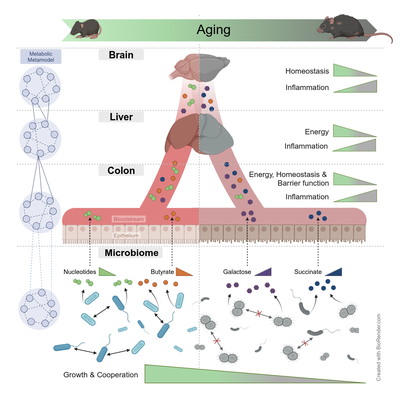
Our research focuses on understanding the complex relationship between the gut microbiome and aging. We’ve identified critical changes in gene expression and microbiome activity that contribute to age-related health decline. In ongoing studies, we’re examining how microbiome interactions affect cognitive functions and healthspan during aging.
In our previous work, we have shown that aging alters gene expression in ways that promote degenerative diseases and reduce cancer risk, highlighting a genetic trade-off. Environmental enrichment (EE) and voluntary wheel running (VWR) have been found to significantly improve cognitive functions in old mice, with EE altering hippocampal gene expression and VWR reducing colon inflammation.
Additionally, we found that aging involves distinct phases of DNA methylation changes, characterized by an early-to-midlife and mid-to-late-life transition which largely involves epigenetic control of nervous system associated genes. We have also discovered that the metabolic activity of the aging microbiome declines, leading to reduced beneficial interactions and downregulation of critical host pathways. This underscores the importance of the microbiome in maintaining intestinal and overall health during aging.
Our ongoing research focuses on understanding microbial contributions to cognitive decline by examining the interactions between brain-resident microglia and the gut microbiome during aging, as well as exploring how social isolation, environmental enrichment, and exercise affect microbiome composition and cognition. Additionally, we are analyzing a mouse aging cohort aiming to reveal those systemic effects of aging, including changes in metabolic functions of the colonic microbiome, that relate to a decline in cognitive function.
Since 2024, our group, led by Dr Georgios Marinos and Professor Dr Christoph Kaleta, has been conducting a joint research project with Beiersdorf (Research Group Dr Elke Groenniger, Hamburg, Germany). The aim is to identify innovative modulators (compounds and/or genes) of skin ageing by integrating genome-scale metabolic modelling, high-throughput omics data, and skin microbiome information, followed by internal validation by the company’s research and development department. The project is implemented through the University’s knowledge and technology transfer company, CAU Innovation GmbH.
Finally, we are investigating the variation in taxonomic and functional microbiome profiles along the gastrointestinal tract and how aging blurs these microbial niches. Our long-term objective is to translate our insights into microbiome-based therapies to enhance cognition as well as health- and lifespan.
Project-related publications
-
Nature Microbiology
·
Metabolic modelling reveals the aging-associated decline of host–microbiome metabolic interactions in mice
Best L, Dost T, Esser D, Flor S, Haase M, Kadibalban AS, Marinos G, Walker A, Zimmermann J, Simon R, Schmidt S, Taubenheim J, Künzel S, Häsler R, Groth M, Waschina S, Witte OW, Schmitt-Kopplin P, Baines JF, Frahm C, Kaleta C
-
Nature Communications
·
Nonlinear DNA methylation trajectories in aging male mice
Olecka M, van Bömmel A, Best L, Haase M, Foerste S, Riege K, Dost T, Flor S, Witte OW, Franzenburg S, Groth M, von Eyss B, Kaleta C, Frahm C, Hoffmann S
-
Nature Communications
·
Transcriptomic alterations during ageing reflect the shift from cancer to degenerative diseases in the elderly
Aramillo Irizar P, Schäuble S, Esser D, Groth M, Frahm C, Priebe S, Baumgart M, Hartmann N, Marthandan S, Menzel U, Müller J, Schmidt S, Ast V, Caliebe A, König R, Krawczak M, Ristow M, Schuster S, Cellerino A, Diekmann S, Englert C, Hemmerich P, Sühnel J, Guthke R, Witte OW, Platzer M, Ruppin E, Kaleta C


Steroid Hormones and the Gut-Brain-Axis
As women age, cessation of ovarian function leads to declining estrogen and progesterone levels, increasing the risk of cardiovascular disease, mood disorders, cognitive changes, and tissue atrophy such as osteoporosis, while simultaneously reshaping microbiome composition in the oral, vaginal, and gut niches. These hormone-driven microbiome shifts matter because the gut microbiome actively recycles host metabolites, including steroid hormones, and can re-activate conjugated estrogens via enzymes such as β-glucuronidases (Best et al., 2025; Cotton et al., 2023). Emerging evidence from human cohort studies and mechanistic gut–brain axis research links menopause-associated dysbiosis to cognitive decline, showing associations with increased neuroinflammation, altered tryptophan metabolism, and changes in microbial metabolites that modulate blood–brain barrier integrity and neurotransmission (Nieto et al., 2025). A deeper understanding of host–microbiome hormone interactions may open new intervention opportunities to preserve cognitive health and quality of life in menopausal women.Project-related publications
Project-related publications
-
Nature Microbiology
·
Metabolic modelling reveals the aging-associated decline of host–microbiome metabolic interactions in mice
Best, L., Dost, T., Esser, D., Flor, S., Gamarra, A. M., Haase, M., Kadibalban, A. S., Marinos, G., Walker, A., Zimmermann, J., Simon, R., Schmidt, S., Taubenheim, J., Künzel, S., Häsler, R., Franzenburg, S., Groth, M., Waschina, S., Rosenstiel, P., … Kaleta, C
Modelling microbiome – host interactions
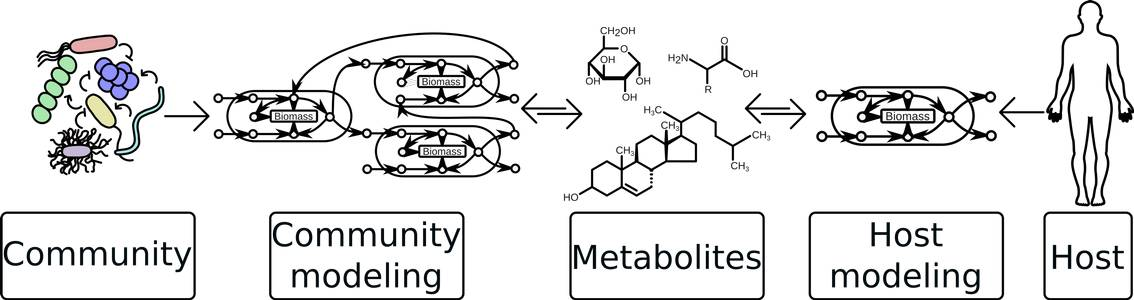
Our research explores host-microbiome interactions across various model organisms, aiming to understand how these interactions influence health and disease. We use metabolic modeling to study these interactions in the nematode Caenorhabditis elegans, focusing on nutrient absorption and genetic alterations. We also investigate the impact of proton-pump inhibitors (PPIs) on the gut microbiome of human users and assess the implications of these microbial changes. Additionally, we study the stable microbiome of the cnidarian Hydra to explore the ecological factors that influence microbial community dynamics.
Host-microbiome interaction in Caenorhabditis elegans
The microbiome plays a crucial role in nutrient absorption and health, and may influence diseases such as metabolic disorders and inflammatory bowel disease. One organism in which these interactions are being studied is the nematode Caenorhabditis elegans. This model has been widely used to explore research questions in embryogenesis, aging, and toxicology, but its microbiome has often been overlooked.
Our research addresses this gap by characterizing the native microbiome of wild C. elegans, allowing us to model basic gut-microbiome processes. We use metabolic modeling on C. elegans and bacterial genome-scale metabolic models (GSMM), taking into account the nutritional context and genetic alterations. These efforts aim to create a high-throughput system to study fundamental biological principles related to host-microbiome interactions.
Proton-pump inhibitors (PPIs) and the human gut microbiome
Proton-pump inhibitors (PPIs) are commonly prescribed drugs used to treat gastrointestinal conditions, but their prolonged use has been linked to increased risks of dementia, infection, gastric cancer, and mortality. PPIs also alter the gut microbiome by reducing gastric acid production, which may affect microbial composition and function in PPI users.
Our research seeks to understand the functional implications of these microbial changes in PPI users. We analyze data from 1280 individuals from the Northern German FoCus cohort, combining microbiome, phenotypic, nutritional, and medication data. Using metabolic models and statistical approaches, we aim to uncover how these changes impact human metabolism and overall health.
Host-microbiome interaction in Hydra vulgaris
Hydra, a freshwater cnidarian, has a simple and stable microbiome consisting of around ten species that contribute to its pathogenic protection, development, and behavior. This model organism is ideal for studying host-microbiome interactions due to its symbiotic relationship with microbes, which is crucial for maintaining homeostasis.
Our research aims to investigate the ecological factors driving changes in the microbial community under various environmental conditions, such as nutrient availability. We are developing a genome-scale metabolic model that integrates Hydra and its microbial community, focusing on how host functions influence microbiome stability. This work will help us identify critical functions that, when lost, may lead to community composition alterations and disease.
Project-related publications
-
Computational and Structural Biotechnology Journal
·
Metabolic modeling of host-microbe interactions
Srinak N, Krüger F, Kaleta C, Taubenheim J
-
The ISME Journal
·
The functional repertoire contained within the native microbiota of the model nematode Caenorhabditis elegans
Zimmermann J, Obeng N, Yang W, Pees B, Petersen C, Waschina S, Kissoyan KA, Aidley J, Hoeppner MP, Bunk B, Spröer C, Leippe M, Dierking K, Kaleta C, Schulenburg H
Towards the rational design of microbiome-based interventions
Our research leverages genome-scale metabolic modeling to design targeted nutritional interventions aimed at modulating the microbiome in ways that promote host health. By using advanced models, we have already developed interventions that successfully increase the abundance of beneficial microbial species. Current projects aim to expand these findings to other host-associated species and human-relevant microbial communities.
While extensive research has been conducted on bacterial communities and their role in host health and disease, there is still limited knowledge about how this understanding can be translated into practical microbiome interventions. Building on our work in host-microbial interactions through genome-scale metabolic modeling, we are using these models to design targeted nutritional interventions.
In a proof-of-principle study, we developed a targeted intervention aimed at increasing the abundance of the host-beneficial species Pseudomonas lurida MYb11 in the microbiome of Caenorhabditis elegans. Using metabolic modeling, we identified a set of potential nutritional supplements that could promote the growth of this protective species. Among the supplements, serine was found to specifically increase the abundance of MYb11 both in vitro and in vivo.
Currently, we are expanding our research to include a broader test community of Caenorhabditis elegans-associated species. Additionally, we are investigating how these nutritional supplements affect a simplified human intestinal bacterial community (SIHUMI), which will help us understand the broader implications of our interventions for human health.
Project-related publications
-
Microbiology Spectrum
·
Metabolic model predictions enable targeted microbiome manipulation through precision prebiotics
Marinos G, Hamerich IK, Debray R, Obeng N, Petersen C, Taubenheim J, Zimmermann J, Blackburn D, Samuel BS, Dierking K, Franke A, Laudes M, Waschina S, Schulenburg H, Kaleta C
Software / pipeline development
We have developed a suite of software tools designed to facilitate metabolic modeling of microbial communities and host-microbiome interactions. These tools help simulate ecological interactions, microbial community metabolism, integrate OMICs data and build integrated models of host and microbiota. All tools are freely available on GitHub.
BacArena & Virtual Colon
BacArena is an R package that enables the simulation of cell communities in a spatiotemporal chemically defined environment in-silico. Based on agent-based modeling, each cellular model can act independently by moving, reproducing, growing, dying, and exchanging molecules in a 2D space. These simulations allow for the study of microbial and host-microbial interactions over time.
Building on BacArena, we developed Virtual Colon, an extension that models bacterial-bacterial and host-bacterial co-metabolism along with the chemical environment of the mammalian intestine, including the mucus layers and host side. Both tools are available on GitHub:
EcoGS
EcoGS is an R package that extends the functionality of MicrobiomeGS2 for microbial community modeling. It predicts ecological interactions between pairs of microbial species by comparing their growth in isolation and within a community. EcoGS allows for the estimation and visualization of the frequency of ecological interactions (mutualism, antagonism, competition, etc.) within different microbial communities.
CORPSE
CORPSE (CObRaPy tool SEt) is a utility package that extends the functionality of the CobraPy package. It provides an easy interface to map transcriptomic data to metabolic models and create context-specific models using the FASTCORE algorithm. This tool is essential for integrating omics data into metabolic models.
MeMoMe
MeMoMe (Metabolic Model Merging) is a software package designed to annotate metabolites in metabolic models, eliminate duplicate reactions, and convert multiple models into a common namespace. It addresses the challenge of integrating metabolic models across different namespaces, facilitating community modeling by automatically matching metabolites using structural and database information.
Our offices are located at Preusserstraße 1-9 (abbreviated as “PS”) and at Michaelisstraße 5 (UKSH Campus, abbreviated as “MS”) as indicated next to each group member. In Michaelisstraße we are located on the third floor at the eastern end of the building (turn right at the end of the floor). At Preusserstraße go to the first floor, than to the left… follow the hallway until you reach a concrete pillar, right of that pillar is the door to our offices.
Project leader
-

Prof. Dr. Christoph Kaleta
Principal Investigator, Speaker(0431) 500-30340
Team
-

Lena Best
Post-Doc -

Jan Taubenheim
Post-Doc -

Dr. Georgios Marinos
Industry Post-Doc -

Kristina Schlicht
Post-Doc -
Stefano Flor
Post-Doc -

Karlis Moors
PhD-student -

Florian Krüger
PhD-student -
Rupinder Kaur
PhD-student -

Andy Mercado Gamarra
PhD-student -

Natchapon Srinak
Post-Doc -

Thomas Dost
Student assistant -

Ann Homscheid
Student assistant -

Emily Schmidt
Student assistant -

Marieke Domdey
Master student -

Handan Müftüoglu
Assistance
Alumni
- Dr. Silvio Waschina
- Dr. Daniela Esser
- Dr. Hamidreza Saadati
- Dr. Jonathan Josephs-Spaulding
- Dr. Johanna Forero Rodriguez
- Dr. Johannes Zimmermann
- Dr. Anuradha Mukherjee
- Dr. Samer Kadibalban
Publications
-
Nature Communications
·
Author Correction: Metabolic modeling reveals a multi-level deregulation of host-microbiome metabolic networks in IBD
Taubenheim J, Kadibalban AS, Zimmermann J, Taubenheim C, Tran F, Schreiber S, Rosenstiel P, Aden K, Kaleta C.
-
Molecular Systems Biology
·
Metabolic modelling reveals increased autonomy and antagonism in type 2 diabetic gut microbiota
Kadibalban AS, Künstner A, Schröder T, Zauleck J, Witt O, Marinos G, Kaleta C.
-
Nature Microbiology
·
Metabolic modelling reveals the aging-associated decline of host–microbiome metabolic interactions in mice
Best L, Dost T, Esser D, Flor S, Gamarra AM, Haase M, Kadibalban AS, Marinos G, Walker A, Zimmermann J, Simon R, Schmidt S, Taubenheim J, Künzel S, Häsler R, Franzenburg S, Groth M, Waschina S, Rosenstiel P, Sommer F, Witte OW, Schmitt-Kopplin P, Baines JF, Frahm C, Kaleta C.
-
Genome Biology
·
gapseq: informed prediction of bacterial metabolic pathways and reconstruction of accurate metabolic models
Zimmermann J, Kaleta C, Waschina S.
-
Cell
·
Host-Microbe-Drug-Nutrient Screen Identifies Bacterial Effectors of Metformin Therapy
Pryor R, Norvaisas P, Marinos G, Best L, Thingholm LB, Quintaneiro LM, De Haes W, Esser D, Waschina S, Lujan C, Smith RL, Scott TA, Martinez-Martinez D, Woodward O, Bryson K, Laudes M, Lieb W, Houtkooper RH, Franke A, Temmerman L, Bjedov I, Cochemé HM, Kaleta C, Cabreiro F.